innovation

mobile fitout

Custom control makes for smooth sailing

The pleasure of cruising inland waterways has been taken to another level with the recent launch of River Dream Boatels at Mannum on the Murray, about one-and-a-half hours east of Adelaide.

The Boatel is designed by prominent Adelaide-based architect, Paul Pruszinski, whose portfolio also includes hotel and aged care accommodation valued at more than $500 million.

Benchmark in vessel fitout

With two level s of living, many luxury hotel features have been incorporated into the Boatel. Paul designed the electrics, which he says are quite complicated and innovative hybrid systems.

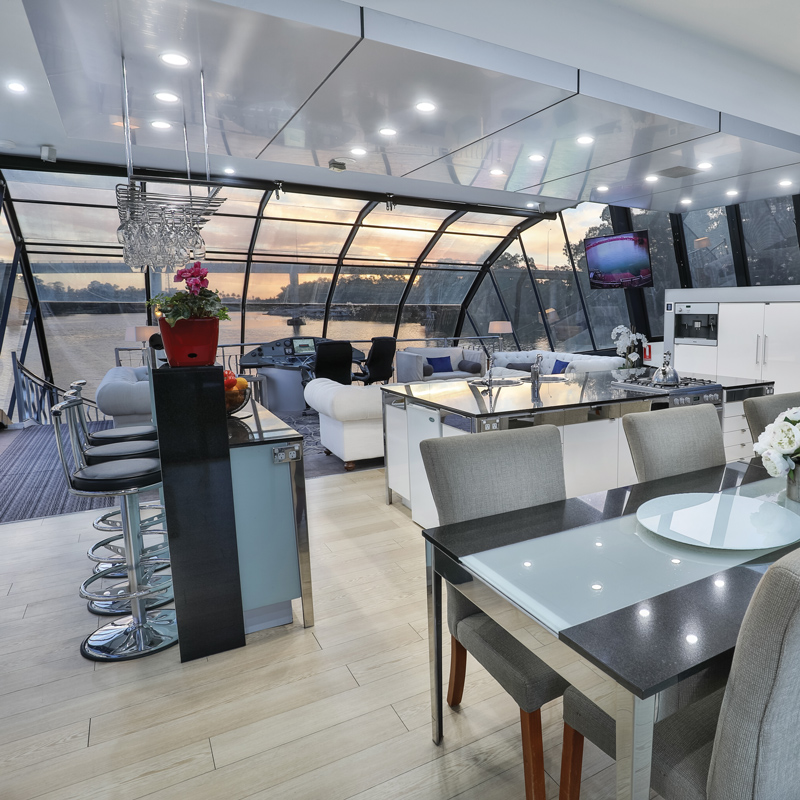
The sky lounge, which is the heart of the craft, is accessed from the lobby by a sweeping grand stair.

A two-storey, wrap-around windscreen gives panoramic views of the waterway, and there is a high-performance, six-channel, surround-sound system with home-theatre widescreen for DVD and video.

Twelve people can be accommodated in the upstairs lounge area, and there is a dining table for 14, together with a highly functional kitchen.

Also located on the upper level is the command centre. Instrumentation includes speed, depth, wind speed, wind direction, engine revs, engine hours, fuel use, fuel efficiency, sewer capacity, air-conditioning and, last but not least, fish-finder.

The Boatel is a complete shift from traditional houseboat design. It has a lightweight and stiff structural system capable of keeping the entire vessel rigid should any corner of its 21.8m x 8.5m frame be lifted.

This provided the design team with complete freedom in the use of glass, tiles, plasterboard and mirrors, a concept not previously enjoyed in the fitout of earlier river vessels.

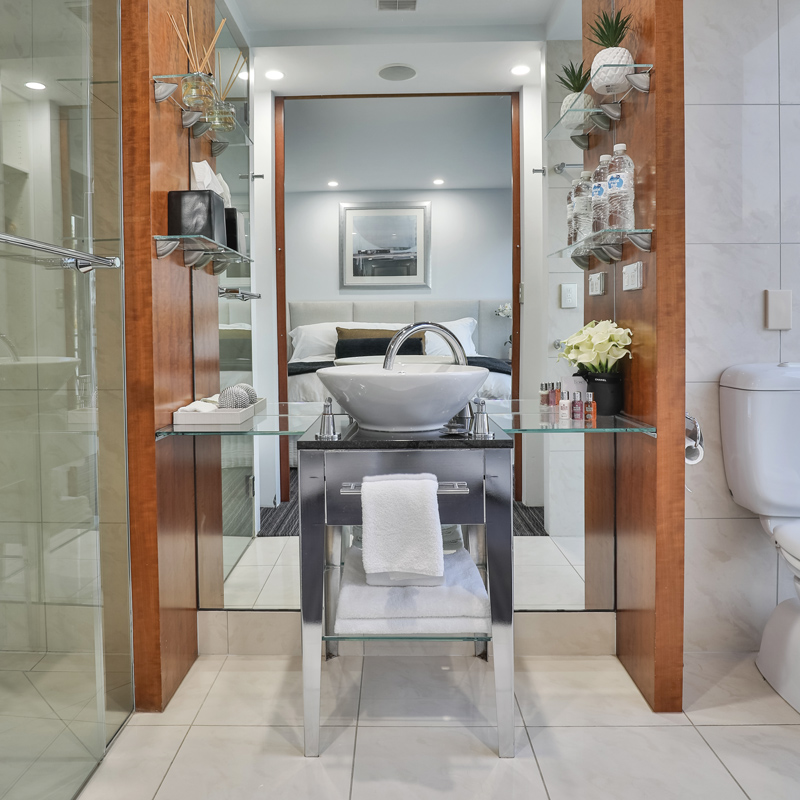
Each of the five bedrooms has a tiled ensuite, including full shower, basin and electric toilet.

Weighing just 45 tonnes and with a draught of 900mm, the Boatel powers along at 10km/h (the maximum permitted speed) on two restricted 110hp Honda 4-stroke motors. The light structure and hydraulic steering mean that the craft is easily manoeuvred.

Onboard computers

According to Paul, the Boatel is the first known riverboat to use a fully computerised electrical system.

“The Boatel usees the latest technology from across the globe to control lights, blinds, windows, propulsion, power generation, power use and entertainment,” he says.

“The system is totally seamless and entirely user-friendly, with no direct guest interaction required for any of the generator, inverter or computer systems.”

“The only exception is a robust and powerful guest-interactive-panel PC, equipped with touch screen technology – so, there is no mouse, joystick or keyboard to worry about.”

The 85 unseen computers and power systems include 12v and 24V DC, and

24V and 240V AC. Power generation and storage are fully independent and automated.

The water-cooled diesel generator is an 8kVA single-phase 13.5kVA 3-phase Kubota Mechalte mounted in the hull. The hull is silenced and the generator operates at 1500rpm to achieve its peak.

Twenty-four batteries in two banks of 2V cells with a mass of 1400kg provide 1350 ampere-hours of storage.

The inverter was originally a 48VpSA unit. However, due to the unit’s unreliability and the lack of available service personnel, it was replaced with two Trace Power Series 24V 2400W units, joined electronically to give a 4800W draw on either unit.

The generator will automatically take over if a draw exceeding a predetermined 8A is exceeded.

Inverters convert the battery power to 240V AC, as well as automatically send a signal to start the generator when the voltage and time conditions are met for charging.

The inverters are also the chargers, and are able to charge, equalise, and float the batteries either by generator or shore power. This is achieved by the system automatically searching for and determining the best source of charge.

The system is setup so that the generator is only a ‘battery charger’, thereby ensuring that the frequency of the supply is maintained at a tolerance of 0.5% off the inverter. This enables the computers to correctly function away from the generator’s unreliable frequency.

The inverter that operates non-computerised equipment can be by-passed in peak load, meaning that short periods of up to 13500W can be tolerated.

GPOs are standard HPM Excel 240V, with no necessity for double pole due to the transformer set-up for shore power charging.

Electric toilets operate off the 12V DC system, which is charged by the spare capacity of the alternators on the 110hp outboards during cruising.

Comfort, convenience and energy-efficiency

Air-conditioning is provided by two evaporative units chosen for their low energy consumption as well as their ability to allow doors and windows to be kept open during cruising.

The Boatel is designed to achieve superior cross and through-ventilation during cruising to reduce air-conditioning loads.

Paul says the lights, blinds and windows are controlled by Conson equipment, a highly robust, fully programmable hotel automation system.

“This has enabled us to achieve excellent flexibility,” says Paul. “For example, the living room lights have been set up an after-dark ‘master on’, and are controlled at the Boatel front door, as well as at the traditional wall switch location, and also at the helm,” he says.

“In addition, the system permits remote start so that the marina managers can turn on a preset set-up from their office when guests arrive after dark.”